Brick by Brick: The Chicago Venues That Forged The Lawrence Arms and Why Losing Them Would Be Losing Everything
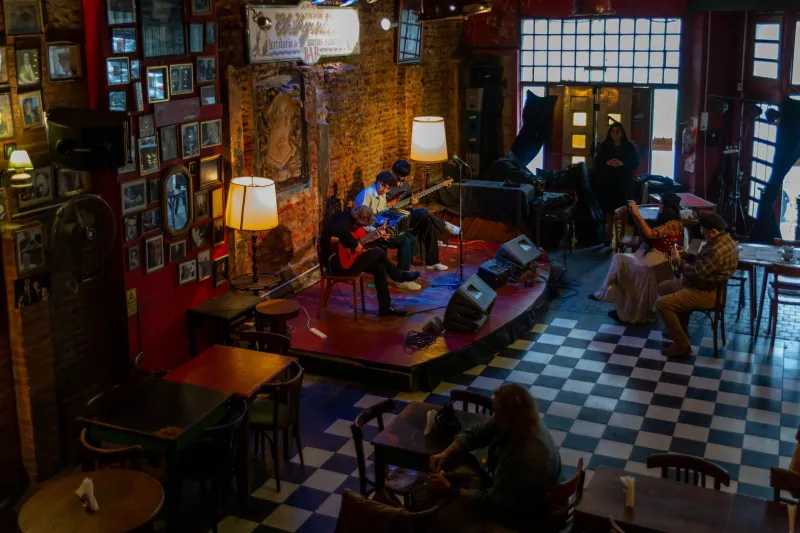
There's a version of The Lawrence Arms that never happens without the right rooms. Not the right label, not the right producer, not the right algorithm — the right rooms. The ones with sticky floors and broken monitors and a sound guy who's been running that same board since 1994. The ones where the ceiling is low enough that the noise bounces back and hits you twice. Those rooms. And for Brendan Kelly, Chris McCaughan, and Neil Hennessy, those rooms were almost always in Chicago.
This city doesn't hand anything to anyone, and it doesn't apologize for that. The venues that nurtured The Lawrence Arms operated on the same philosophy. You showed up, you earned the crowd, you played like it mattered — because if you didn't, you weren't coming back. That crucible is where this band got hard.
The Basement Logic That Started Everything
Before anyone was booking The Lawrence Arms onto real stages, they were doing what every Chicago punk band did: playing basements. Not as a stepping stone. As the whole point. The basement show scene on the North Side in the late '90s operated as its own ecosystem — word-of-mouth bills, hand-stapled flyers, fifty kids crammed into a space meant for a water heater and some old bikes.
Those sets demanded a specific kind of performance. There was no stage to hide behind, no lighting rig to make you look bigger than you were. It was eye-to-eye, elbow-to-elbow, and if the songs weren't landing, everyone in the room knew it immediately. That intimacy is baked into the DNA of Lawrence Arms records. The way their best songs feel like they're being sung directly at you, not performed for a room — that didn't come from a recording studio. It came from playing three feet away from the people who actually gave a damn.
The Fireside Bowl Era and What It Actually Meant
If you were doing punk in Chicago in the late '90s and early 2000s, the Fireside Bowl was the center of the universe. Originally a bowling alley — and still a functioning one, which was part of the chaos — the venue became the unofficial home of Chicago's DIY punk scene almost by accident. The back room hosted shows that would become legendary, and The Lawrence Arms played there repeatedly during a stretch when they were figuring out exactly who they were going to be.
What the Fireside gave them was permission to fail in front of an audience that was rooting for them. That crowd wasn't passive. They were participants. When something worked, they let you know. When something didn't, they let you know that too. It was a feedback loop that forced bands to sharpen fast or disappear. The Lawrence Arms sharpened. The confrontational energy in songs from that period — the refusal to soften an edge or smooth over a rough lyric — reflects a band that learned to trust an honest room over a polite one.
The Fireside eventually stopped hosting shows, and its absence left a real hole in the ecosystem. That hole never fully closed.
Empty Bottle, Subterranean, and the Next Level Up
As the band's profile grew, the rooms changed but the ethos didn't. The Empty Bottle on Western Avenue became a regular stop — a place with actual production values, a real sound system, and a booking history that includes some of the most important independent music of the last thirty years. Playing the Bottle meant something. It still does.
Subterranean in Wicker Park served a similar function, a mid-size room that could hold a crowd big enough to feel like a real show without losing the closeness that made Lawrence Arms performances feel urgent. These weren't arenas. They were rooms where the band could still make eye contact with the people in the back row, and that mattered. It still matters.
Both venues have survived longer than most, partly through sheer stubbornness, partly because they've built genuine community relationships that go beyond just selling tickets. But surviving isn't the same as thriving, and the pressure on both has never been heavier.
The Real Estate Problem Is a Punk Problem
Here's the part that should make you angry: the venues that built The Lawrence Arms, and dozens of bands like them, are under existential threat right now. Chicago's real estate market has been chewing through the neighborhoods that historically housed its independent music scene. Wicker Park, Logan Square, Pilsen — these areas have been reshaped by development pressure that has no interest in preserving a room where a band can play for a hundred people and charge eight dollars at the door.
The math doesn't work for developers. A three-hundred-capacity venue sitting on a lot in a gentrifying neighborhood is just land with a liquor license on it. The cultural value — the fact that this is where a generation of musicians learned to be musicians, where a generation of fans learned to be fans — doesn't appear on a balance sheet.
This isn't a Chicago-specific problem, but Chicago feels it in a particular way because the city's punk identity is so tied to specific physical spaces. When a venue closes here, it's not just a business shutting down. It's an institution disappearing. It's the room where someone saw their first show, where someone played their first set, where a band figured out the song that ended up on the record that changed somebody's life.
Why This Fight Is Part of the Lawrence Arms Story
The Lawrence Arms have never been a band that pretended politics existed somewhere outside the music. Their lyrics have always engaged with the world as it actually is — messy, unfair, worth fighting for anyway. The fight to preserve independent venues fits squarely inside that worldview.
Supporting the venues that made them isn't nostalgia. It's consistency. It's the same refusal to let the things that matter get quietly dismantled by forces that don't understand their value. When the band chooses to play a smaller room over a larger one, when they show up for benefit shows and community events, when they talk openly about the importance of the DIY infrastructure they came up through — that's not a PR strategy. That's the whole point.
What You Can Actually Do
If you're reading this and you care about any of this — the band, the music, the rooms — there are concrete moves. Go to local shows at independent venues, even when it's a band you've never heard of. Buy a ticket instead of getting on the guest list. Buy merch directly from the venue. Show up early. Tip the bartender. Talk to the sound person like they're a human being who matters, because they are and they do.
Organizations like the National Independent Venue Association (NIVA) have been fighting at the policy level for real protections. Chicago has its own local advocacy groups working to designate certain venues as cultural landmarks. These efforts need bodies and voices behind them.
The Lawrence Arms didn't build a career in a vacuum. They built it in rooms that took a chance on them, rooms that the city's punk community fought to keep open. That community is still here. Those rooms still need it.
The floor is still sticky. The monitor is still broken. Show up anyway.