Slow Burn Wins: Why The Lawrence Arms' Refusal to Play the Game Is the Smartest Move in Punk Right Now
There's a particular kind of pressure that every working band in 2024 feels the moment they open their laptop. The streaming dashboards. The engagement metrics. The quiet but relentless suggestion that if you just tweaked the sound a little, leaned into that one riff that tested well, maybe posted a thirty-second clip of yourself crying in a parking lot — you could crack the algorithm. You could go viral. You could matter.
The Lawrence Arms looked at all of that and basically shrugged.
Not out of ignorance. Not out of laziness. Out of something closer to hard-earned conviction. And in a landscape where most bands are contorting themselves to fit whatever the moment demands, that refusal has quietly turned Brendan Kelly, Chris McCaughan, and Neil Hennessy into something genuinely rare: a band that younger artists are actually studying.
What Consistency Actually Looks Like Over the Long Haul
It's easy to romanticize staying true to yourself. It's a lot harder to watch your contemporaries rack up playlist placements while you're loading your own gear into a club that holds three hundred people on a Tuesday night in Omaha. The Lawrence Arms have lived that reality for over two decades, and the fact that they're still here — still releasing records, still selling out shows, still generating the kind of word-of-mouth buzz that no marketing budget can manufacture — tells you something important about the math.
Their catalog reads like a straight line drawn with intention. From A Guided Tour of Chicago through Metropole and into their more recent work, there's a coherent artistic DNA running through everything they've made. The production values have shifted. The band has grown up. But the essential honesty of the songwriting, that willingness to sit inside something uncomfortable and write about it with both humor and weight, has never wavered.
That consistency isn't just aesthetically admirable. In 2024, it's strategically brilliant, even if it was never conceived as strategy.
The Authenticity Premium in an Algorithm-Driven World
Here's the thing about younger listeners right now — they're exhausted. Gen Z fans, in particular, have grown up inside a media environment so saturated with manufactured sincerity that they've developed finely tuned detectors for the fake stuff. They can smell a brand pivot from a mile away. They know when a band is performing relatability rather than actually being relatable.
The Lawrence Arms have never had to perform anything. The work speaks for itself, and it speaks in a voice that doesn't change depending on who's in the room. That kind of steadiness reads as deeply trustworthy to audiences who are used to watching artists reinvent themselves every eighteen months based on whatever Spotify's editorial team seems to be rewarding.
Talk to anyone who's gotten into the band in the last few years — and there are more of them than you might expect — and you'll hear a version of the same story. Someone handed them Oh! Calcutta! or The Greatest Story Ever Told, they listened through once and thought it was decent, then something made them go back. And then they couldn't stop. The catalog has a gravitational pull that builds over time, which is almost the opposite of how music discovery is supposed to work in the streaming era. You're not supposed to be able to build a new fan through slow accumulation. But The Lawrence Arms keep doing it anyway.
Touring Like It Still Means Something
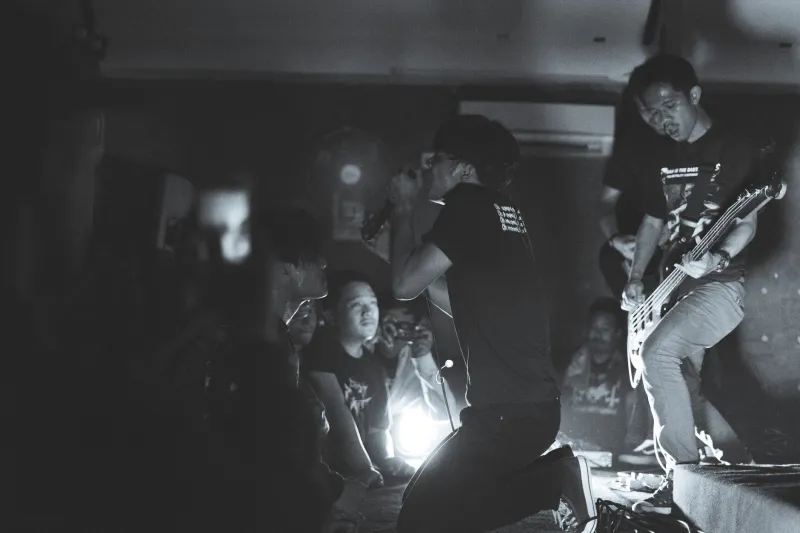
The live show strategy matters here too. While plenty of acts have retreated into the festival circuit or leaned on nostalgia-tour economics to keep the lights on, The Lawrence Arms have maintained a touring approach that prioritizes actual connection over spectacle. Smaller rooms. Cities that don't always make the major-market itinerary. Shows where the band and the audience are close enough to make eye contact.
That's not a cost-cutting measure dressed up as philosophy. It's a deliberate choice about what kind of relationship the band wants to have with the people who show up. And it creates an experience that's essentially impossible to replicate on a screen, which is a genuinely radical thing to offer in a moment when so much of music consumption has become passive and solitary.
Emerging bands are noticing. There's a growing contingent of younger punk and indie acts — particularly in Chicago but spreading outward — who are explicitly citing The Lawrence Arms as a model for how to build something durable. Not just musically, but structurally. The idea that you can maintain creative control, keep your fanbase genuinely engaged, and build a career on your own terms without ever having to sacrifice the thing that made your music worth caring about in the first place.
The Influence You Can't Quite Quote
Influence is a funny thing to measure. It doesn't always show up in obvious sonic borrowing or direct name-drops in interviews. Sometimes it's more atmospheric — a shared understanding of what the work is supposed to be for, passed down through observation and osmosis.
The Lawrence Arms' influence on contemporary punk operates a lot like that. You hear it in bands that prioritize lyrical specificity over vague emotional gestures. You feel it in the way certain acts carry themselves on stage, like they're not performing for an imaginary future audience but for the actual people standing in front of them right now. You see it in the DIY ethic that refuses to treat the business side of music as something separate from the artistic side — as if the decisions about how you release and tour and engage with your audience are just as much a part of the art as the songs themselves.
That's a Lawrence Arms lesson, whether the bands drawing on it can trace the lineage directly or not.
Why the Slow Road Is the Only Road
None of this is to suggest that The Lawrence Arms have had it easy or that their path is some kind of frictionless template anyone can follow. Two decades of making punk rock on your own terms involves an enormous amount of grinding, sacrifice, and the particular psychological endurance required to keep believing in the work when the culture seems to be looking elsewhere.
But 2024 is starting to look like the moment when all of that endurance pays a dividend that was never guaranteed. The algorithm-chasing strategy is showing its cracks. Viral moments don't translate to actual fanbases. Listeners are hungry for something that feels like it was made by real people who actually meant it.
The Lawrence Arms meant it. They always did. And the bands smart enough to study that — to understand that the slow burn is the only kind that lasts — are going to be the ones still standing when the next wave of trends washes out.
Chicago punk built this. And it's still building.