Outlasting the Hype: Why Younger Bands Are Taking Notes From The Lawrence Arms' Playbook
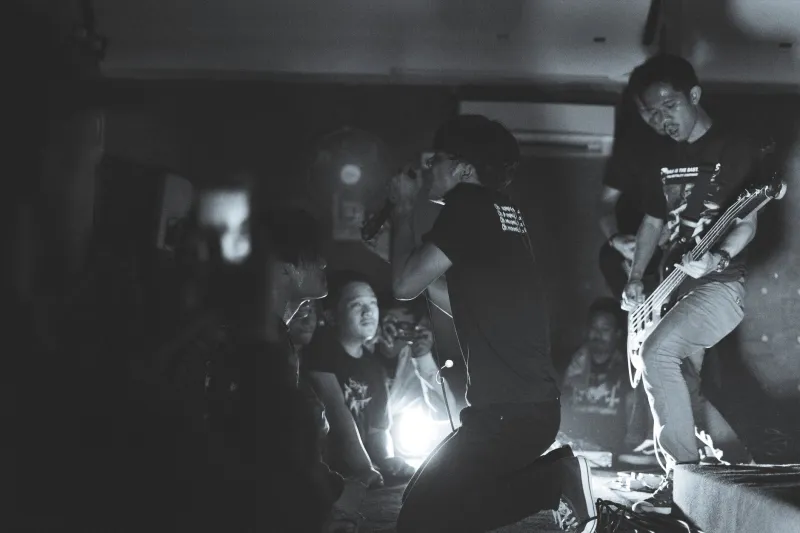
There's a version of success that looks great on a dashboard. Streams in the millions. A TikTok sound that lives rent-free in everyone's head for three weeks. A Spotify editorial playlist placement that feels like validation until it doesn't. And then there's the other kind — the kind that doesn't photograph well, that doesn't spike on any chart, but somehow keeps a band relevant, respected, and genuinely loved across two-plus decades.
The Lawrence Arms are that other kind.
Chris McCaughan, Brendan Kelly, and Neil Hennessy have never been the biggest band in any room they weren't actively playing in. They haven't chased crossover appeal. They haven't softened their edges for a broader audience or repackaged their identity for a new platform every eighteen months. What they've done instead is something that looks almost radical by 2024 standards: they kept making music that meant something to them and trusted that it would mean something to someone else, too.
Turns out, that trust compounds over time.
The Quiet Influence Nobody's Talking About
Ask around in Chicago's current punk and indie underground and something interesting happens. Bands that are barely old enough to have caught a Lawrence Arms show in their teens will name-drop Apathy and Exhaustion or Oh! Calcutta! with the same reverence that older heads reserve for the Replacements or Hüsker Dü. These aren't casual listeners. These are working musicians who have absorbed the Lawrence Arms' catalog as a kind of operating manual.
What they're studying isn't just the music — though the music is undeniably the foundation. They're studying the posture. The way the band has consistently declined to treat their audience as a demographic to be monetized. The way they've maintained creative control without turning it into a manifesto. The way they've stayed close enough to their roots that a kid discovering them today gets essentially the same band that blew minds at the Double Door in 2003.
That kind of consistency is harder than it sounds. The music industry in 2024 is designed, at nearly every level, to reward novelty and punish patience. Streaming algorithms favor new releases over catalog depth. Social media cycles burn through artists faster than ever. The pressure to pivot — to chase whatever sound is getting traction this quarter — is relentless and often disguised as good advice.
The Lawrence Arms never bought it.
Slow Growth as a Survival Strategy
Here's the thing about building something slowly: the foundation actually sets. Bands that explode overnight often find themselves structurally dependent on that initial burst of attention. When the attention moves on — and it always moves on — there's nothing underneath to hold the weight.
The Lawrence Arms built differently. Every record added listeners without shedding the ones who came before. Every tour reinforced the live reputation that, for a band like this, is the real currency. The community that grew up around them didn't form because of a campaign or a placement. It formed because the music kept delivering, night after night, record after record, in a way that felt personal rather than transactional.
That's the model younger bands are internalizing. Not "how do we go viral" but "how do we give people a reason to still care about us in ten years." It's a longer game, a harder game, and in the current landscape it can feel almost counterintuitive. But the evidence keeps stacking up that it's the only game worth playing if you're serious about longevity.
What the New Class Is Actually Learning
Spend any time talking to emerging acts working the Chicago circuit right now and a few recurring themes surface when The Lawrence Arms come up.
First: authenticity isn't a brand strategy, it's a prerequisite. The Lawrence Arms never performed being a punk band. They just were one, with all the messiness and conviction that implies. Younger musicians clocking this understand that audiences — especially punk audiences — have finely tuned radar for performance versus reality. You can't fake your way through twenty years.
Second: the venue matters. The Lawrence Arms' long-standing preference for rooms where they can actually see the people they're playing for isn't just aesthetic. It's a philosophy about the relationship between a band and its community. Playing the Metro or the Empty Bottle instead of chasing a theater upgrade signals something. It says the show is the point, not the production.
Third: the catalog is the asset. In a streaming economy that devalues individual songs almost by design, having a deep, cohesive body of work becomes increasingly valuable. Fans who love one Lawrence Arms record tend to fall into the whole catalog. That kind of depth creates listeners who stick around, who bring friends, who buy the record even when they don't have to.
The Mentor They Never Applied to Be
None of this is the result of The Lawrence Arms positioning themselves as elder statesmen or industry guides. They haven't launched a podcast about the business of punk or started mentorship programs for emerging acts. The influence is ambient, transmitted through the work itself and through the example of how they've conducted their career.
That's actually what makes it credible. Mentorship that gets announced tends to be less effective than mentorship that gets demonstrated. The Lawrence Arms demonstrate it every time they put out a record that sounds like them and nobody else. Every time they play a show that prioritizes the room over the reach. Every time they resist the gravitational pull toward whatever version of themselves would be easier to market.
In 2024, that kind of resistance is genuinely instructive. The landscape is littered with bands that optimized themselves into irrelevance, chasing trends until they no longer had a sound anyone could identify as distinctly theirs. The Lawrence Arms opted out of that cycle early and never looked back.
Why It Matters Right Now
The post-streaming music economy is still being figured out in real time. The rules keep changing. The platforms keep shifting. What worked three years ago doesn't necessarily work today, and what works today will probably look different in another three years.
In that environment, the bands with the clearest sense of who they are have a structural advantage. They're not at the mercy of whatever the algorithm is rewarding this week because they were never trying to game the algorithm in the first place. Their audience found them through the music, stays for the music, and will follow them wherever the music goes.
The Lawrence Arms built that kind of audience before most of the current platforms existed. They've maintained it through every shift in how music gets distributed, discovered, and consumed. That's not an accident. It's the result of consistently choosing the harder path — the one that prioritizes integrity over convenience, longevity over immediacy, and community over reach.
For any band trying to figure out how to survive the next decade with their identity intact, that's not just an interesting story. It's a blueprint. And the fact that it comes from a three-piece punk band from Chicago that never needed anyone's permission to do things their way makes it all the more worth studying.