Small Rooms, Big Truth: Why The Lawrence Arms Keep Choosing the Dive Over the Dome
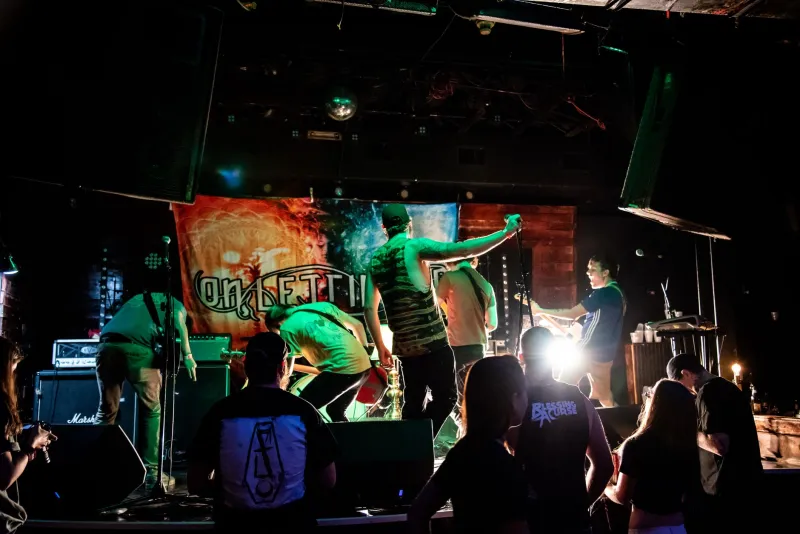
There's a moment that happens at a Lawrence Arms show that doesn't happen anywhere else. You're standing maybe thirty feet from the stage — close enough to see the set list taped to the floor, close enough to watch Brendan Kelly's face when he hits a line that clearly still means something to him — and the whole room kind of locks in together. Nobody's watching through a phone screen. Nobody's waiting for a hit they recognize from a playlist. Everyone in that building knows exactly where they are and why they came.
That moment isn't an accident. It's the product of a very deliberate set of choices about where The Lawrence Arms will and won't play. And those choices, if you look at them long enough, start to look less like logistics and more like a value system.
The Arithmetic of Intimacy
Let's be clear about what we're talking about. The Lawrence Arms are not a band scrambling for opportunities. They've got the catalog, the reputation, and the fanbase to book significantly larger rooms than they typically do. Riot Fest knows who they are. Festival promoters know who they are. The offers exist.
They just keep saying no to a lot of them.
The sweet spot for a Lawrence Arms tour date tends to be somewhere between 300 and 1,500 capacity. Clubs like Metro in Chicago, venues like The Sinclair in Boston or Bowery Ballroom in New York — rooms with actual histories, rooms where the sound guy has been working the board for fifteen years and actually gives a damn about the mix. That range isn't arbitrary. It's the zone where a punk show can still function as a punk show rather than a production.
Once you cross into shed territory — the 5,000-seat amphitheaters with lawn sections and $14 beers and sound that bounces off concrete in ways nobody can fully predict — something fundamental changes. The transaction shifts. You're no longer attending a show; you're attending an event. And events, by design, are built for the casual observer. The Lawrence Arms have never been particularly interested in the casual observer.
What They Won't Touch (And Why)
Venue ethics matter to this band in ways that go beyond sound quality and sightlines. The conversation around which stages are acceptable and which aren't runs deeper than aesthetics.
There are the obvious disqualifiers: venues owned by corporations with documented histories of mistreating staff, rooms that operate under union-busting policies, festival lineups that platforming acts or organizers with values that run counter to everything the band has spent twenty-plus years standing for. The Lawrence Arms have been around long enough to know the difference between a promoter who's in it for the culture and one who's in it to extract from the culture.
But it also gets more granular than that. There's a real consideration given to whether a room actually serves the audience — whether the sightlines work, whether the staff treats people decently, whether the neighborhood surrounding the venue is one the band feels comfortable directing their fanbase toward. These aren't questions that get asked at the arena level. At the arena level, you show up, you play, you load out, and you move on. The Lawrence Arms don't operate like that.
Sound as a Non-Negotiable
Ask anyone who's worked sound for punk shows at multiple venue sizes and they'll tell you the same thing: smaller rooms done right are almost always better. The physics are just more forgiving. You're not fighting the room's natural reverb, you're not trying to project clean guitar tones across 200 feet of open air, and you're not relying on a PA system that was designed primarily for country acts and corporate events.
For a band whose records are as sonically layered as The Lawrence Arms' — where the interplay between Kelly's bass, Chris McCaughan's guitar work, and Neil Hennessy's drumming actually rewards close listening — sound quality isn't a secondary concern. It's central to whether the show lands the way it's supposed to. A muddy mix in a cavernous room doesn't just make the music harder to hear; it makes it harder to feel. And feeling it is the whole point.
The band has been known to walk away from situations where the sound setup didn't meet a basic standard. Not as a diva move, but as a refusal to present their work in a context that actively undermines it. That's a distinction worth making.
The Community Factor
Here's the thing about small venues that doesn't always get discussed in these conversations: they're community infrastructure. The 500-cap club in your city isn't just a place where shows happen. It's the room where local bands cut their teeth, where touring acts from across the country stop and actually interact with the city they're visiting, where a scene sustains itself across decades.
When The Lawrence Arms play a room like that, they're not slumming it. They're participating in something. They're part of a continuum that connects the Chicago DIY spaces of the '90s to whatever version of that ecosystem exists in your city right now. Playing the arena version of that show would sever that connection entirely.
There's also something to be said for what it signals to the audience. When a band that could theoretically be playing much larger rooms keeps showing up at the Metro or the Riot Room or the Waiting Room, it communicates a specific thing: we're not here to extract from you. We're here because this is where the thing actually happens.
What Gets Preserved
At the end of the night, after the encore and the load-out and the long drive to the next city, what The Lawrence Arms preserve by playing small rooms is the actual experience of seeing The Lawrence Arms. Not a spectacle built around them. Not a brand activation with their name on it. The real thing — sweaty, loud, sometimes chaotic, occasionally transcendent.
That experience is rare now. Genuinely rare. Most bands at their career stage have made the trade, and you can't fully blame them. The economics of the music industry in 2024 make the bigger-room math look very attractive. Streaming has gutted album revenue, touring is how you survive, and bigger rooms mean bigger guarantees.
But there's a cost to that trade that doesn't show up on the balance sheet. The Lawrence Arms seem to understand that cost better than most. And every time they book themselves into a club with sticky floors and a capacity that means you can actually see their faces, they're making a statement that their fanbase hears loud and clear.
Some things are worth more than the upgrade. The room that fits right is the room that's right. And nobody in that 500-cap club, singing along to every word, is wishing they were somewhere bigger.