Still Loud After All These Years: The Lawrence Arms Fans Who Grew Up and Kept Going
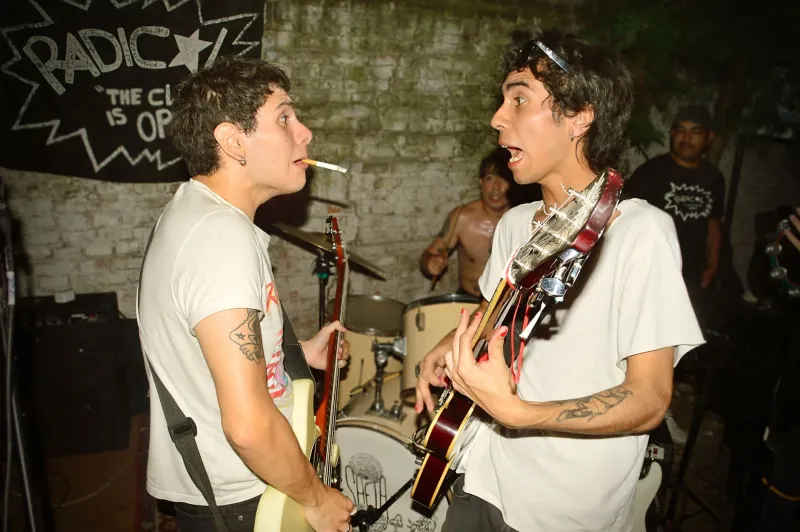
The kid in the back of the venue is 19. He's got the band's name written on his shoes in marker and he knows every word to every song on Oh! Calcutta! He is, in every visible way, exactly the demographic that punk rock is supposed to belong to.
The guy standing next to him is 43. He's got a mortgage, two kids who are starting to get into music themselves, a job that requires him to wear something other than a band shirt at least three days a week, and a slightly worse back than he had when he first heard Apathy and Exhaustion in a dorm room in 2003. He also knows every word to every song on Oh! Calcutta!
Both of them are here for the same reason. Neither of them is doing it wrong.
The Music That Refuses to Let You Go
Most punk rock has an expiration date. Not in terms of quality — plenty of records made in basements and practice spaces 30 years ago still rip — but in terms of relevance. The anger that makes a 19-year-old feel seen can start to feel performative or nostalgic by 35. The rebellion that felt urgent at your first show can calcify into a pose.
The Lawrence Arms are a strange exception to this pattern, and it's worth asking why.
The short answer is that their catalog was never really about the performance of youthful rebellion. It was always about the experience of being a specific kind of person in a specific kind of world — someone trying to stay honest in the face of failure, trying to find meaning in the gap between who you thought you'd be and who you actually are, trying to keep the people you love close while everything keeps moving.
That subject matter doesn't expire. If anything, it compounds.
"When I was 22, I thought 'Recovering the Opposites' was a song about a rough year," says Kevin M., a Chicago-area fan who's been following the band since the early 2000s. "Now I'm 41, and I've had the rough years. The song means something completely different. It means more. It's like it was waiting for me to have enough life to actually hear it."
The Parents in the Pit
One of the more quietly remarkable things happening at Lawrence Arms shows over the last several years is the number of families in the room. Not in the passive, nostalgic sense of adults dragging their bored teenagers to see their old band. In the active, genuine sense of parents who still love this music bringing kids who are actually into it.
Some of that is organic — kids who grew up in houses where the Lawrence Arms were in regular rotation eventually develop their own relationship with the catalog. Some of it is more intentional, parents actively sharing something that mattered to them with people they're raising.
Either way, the result is a room that spans generations in a way that feels earned rather than manufactured.
"I brought my daughter to her first show last year," says Theresa L., a fan from outside Pittsburgh who's been going to Lawrence Arms shows since 2006. "She's 16, she'd been listening to the records for a couple of years on her own. Standing there watching her have the same experience I had when I was her age — it was genuinely one of the best nights of my life. And the songs felt different because I was watching her hear them for the first time."
This is not a thing that happens with most bands. It requires a catalog that actually holds up, an audience that stayed engaged rather than drifting away, and music that can mean something to a teenager and her mother simultaneously without compromising either experience.
What Failure Sounds Like at 40
There's a particular emotional territory that the Lawrence Arms have always inhabited that becomes more specific and more valuable as you accumulate more life. It's the territory of the person who tried, didn't quite make it the way they planned, and had to figure out what to do with that.
At 20, those lyrics feel like a warning or a commiseration. At 40, they feel like a map.
Kelly and McCaughan write with a specificity about adult disappointment — about the gap between ambition and outcome, about the exhaustion of maintaining relationships and convictions over time, about the strange comfort of community in the face of individual failure — that most punk bands never get close to. It's not that the music is more literary or more sophisticated than its peers. It's that it's more honest about a particular kind of emotional experience that doesn't resolve neatly.
Life doesn't resolve neatly. The older you get, the more that's true. And so the music keeps meeting you where you are.
"I went through a divorce a few years ago," says Marcus A., a fan from Austin. "I was in a really bad place. And I went back to the Lawrence Arms catalog the way you go back to something that's always told you the truth. It wasn't comforting in a soft way. It was comforting in the way that being told the truth is comforting, even when the truth is hard. That's rare. That's worth showing up for."
The Refusal to Become a Nostalgia Act
Part of what keeps the Lawrence Arms relevant to fans who've been around for two decades is that the band itself has refused to become a museum piece. They're still writing. Still recording. Still saying something new rather than touring exclusively on the legacy of what they made in their 20s.
That matters more than it might seem. A band that's only willing to exist as a greatest hits machine is essentially asking its audience to stop growing too — to freeze themselves at the age they were when the music first mattered. The Lawrence Arms have never asked that of anyone.
The result is a fanbase that's allowed to keep moving. To bring new experiences to old songs and find new meanings. To show up at 43 with a bad back and a kid in tow and feel like the room was made for them.
The 19-year-old with the marker on his shoes and the 43-year-old next to him are both right about this music. That's not a contradiction. That's the whole point.